💥
Tool calls fail silently or repeat non-idempotentlyAction systems need contracts, retries, idempotency, and observable failure modes.
Reliable agents are not only a prompt-engineering problem. They are systems, data, security, observability, governance, and operating-model problems that must be engineered as one production stack.
Source deck label: Confidential · DataKnobs 2026
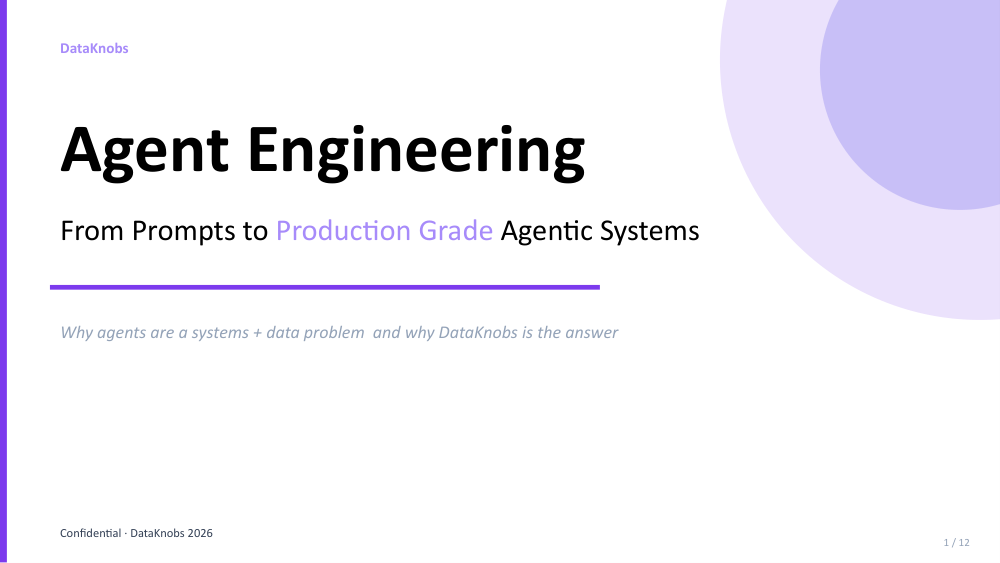
The source deck argues that prompt quality is often not the production bottleneck. Tool behavior, reproducibility, state isolation, prompt injection, and model drift are systems failures.
Action systems need contracts, retries, idempotency, and observable failure modes.
Without full run traces, root-cause analysis becomes slow or impossible.
State and memory require ownership, isolation, retention, and lifecycle rules.
Agent security must protect action boundaries as well as content boundaries.
Versioned models and eval gates are the change-control layer.
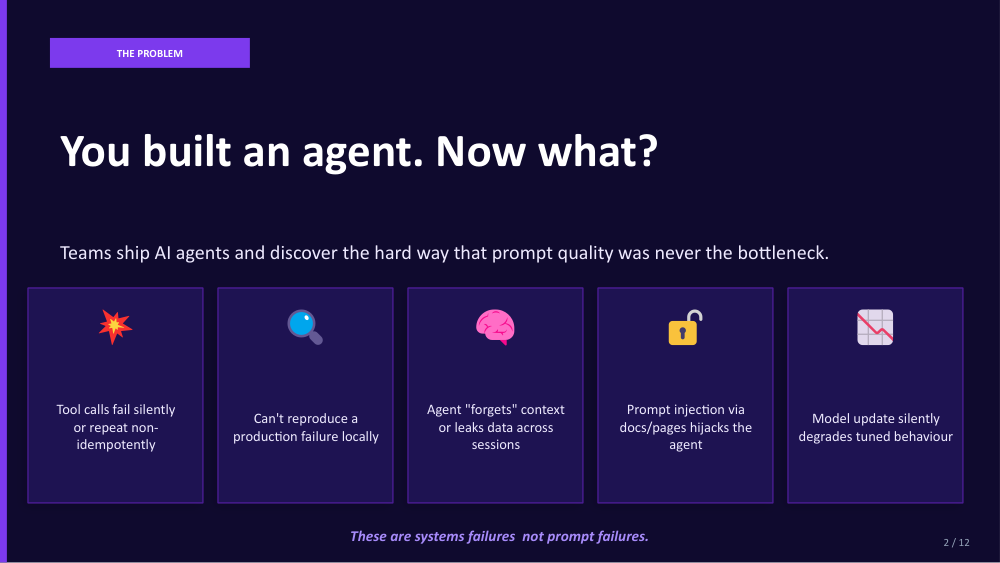
Prompt engineering optimizes a single interaction. Agent engineering optimizes a recoverable, observable run that can call tools, maintain state, enforce policy, and survive change.
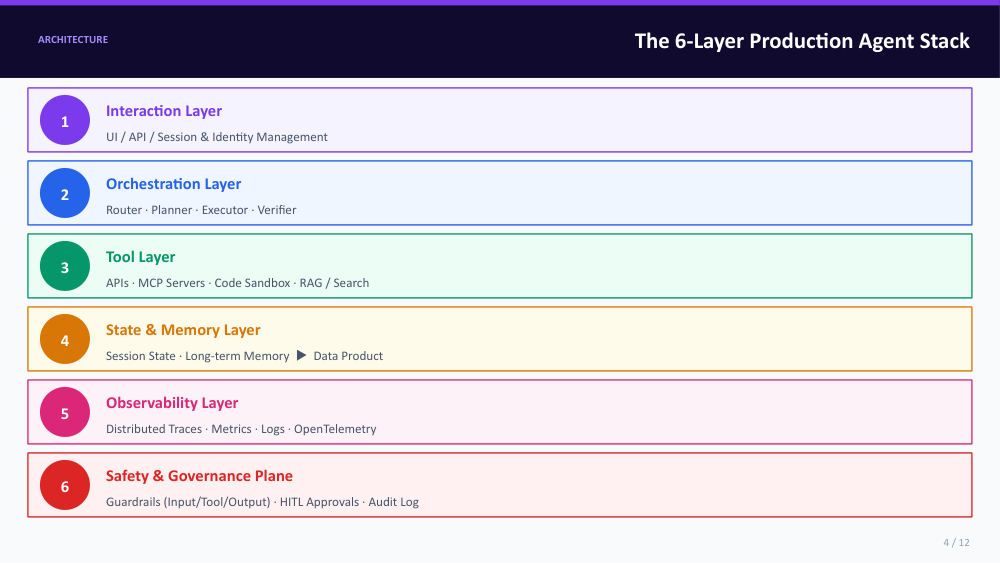
The deck organizes a production agent into six layers, ending with a cross-cutting safety and governance plane.
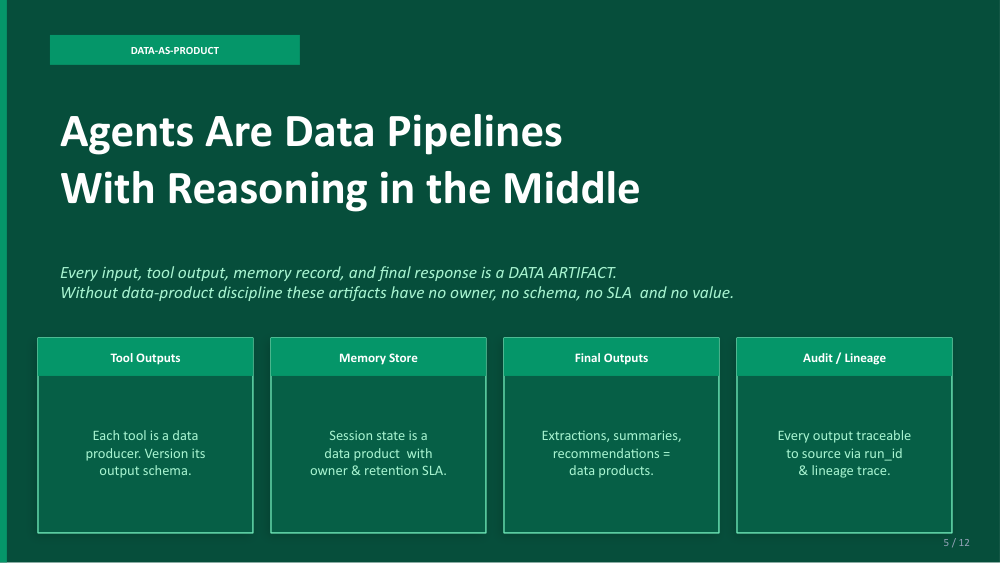
Every input, tool output, memory record, and final response becomes a data artifact. The deck argues these artifacts need ownership, schemas, SLAs, retention, validation, and lineage.
Each tool is a data producer. Version its output schema.
Session state is a data product with an owner and retention SLA.
Extractions, summaries, and recommendations are data products.
Trace every output to source with run_id and lineage.
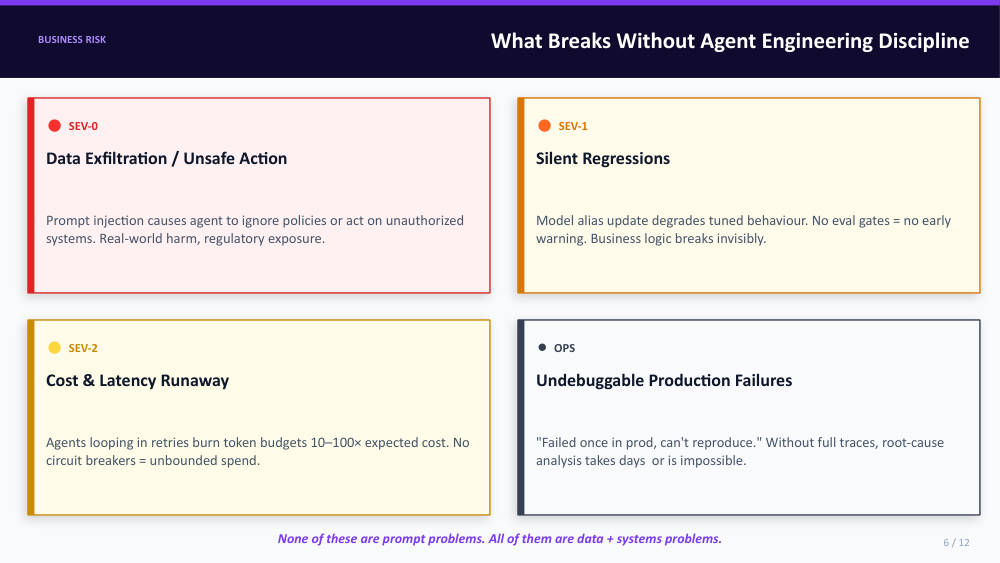
The deck prioritizes four production failure classes: unsafe actions, silent regressions, runaway cost/latency, and failures that cannot be debugged.
Prompt injection can cause an agent to ignore policy or act on unauthorized systems, creating real-world and regulatory exposure.
Model alias changes can degrade tuned behavior without an early warning when eval gates are missing.
Retry loops can consume 10-100× expected token budgets when circuit breakers are absent.
Without full traces, a one-off production failure can take days to root-cause or remain unreproducible.
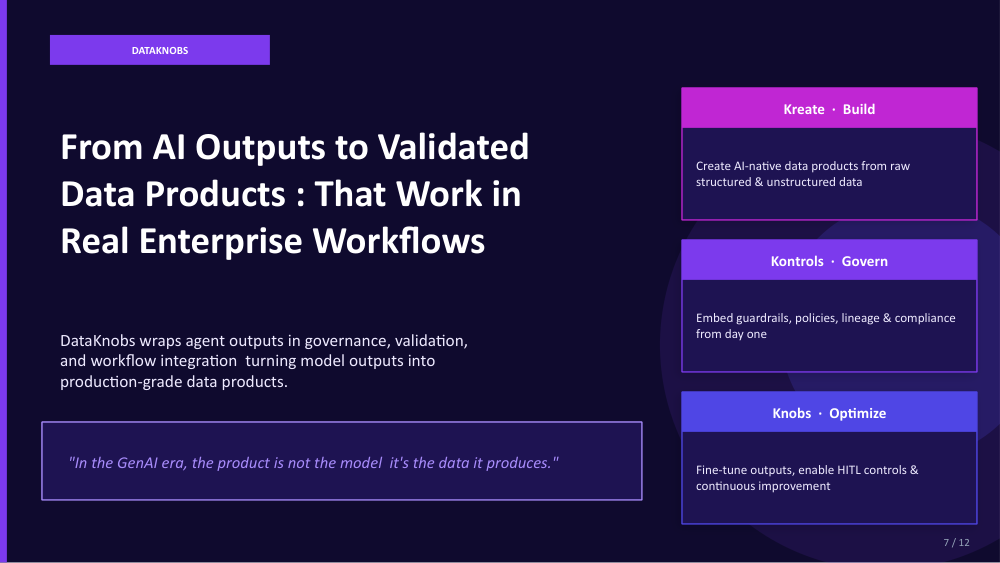
The executive deck positions DataKnobs as the layer that wraps agent outputs in governance, validation, workflow integration, and continuous improvement so they can operate inside real enterprise workflows.
Create AI-native data products from raw structured and unstructured data.
Embed guardrails, policies, lineage, and compliance from day one.
Fine-tune outputs, enable HITL controls, and drive continuous improvement.
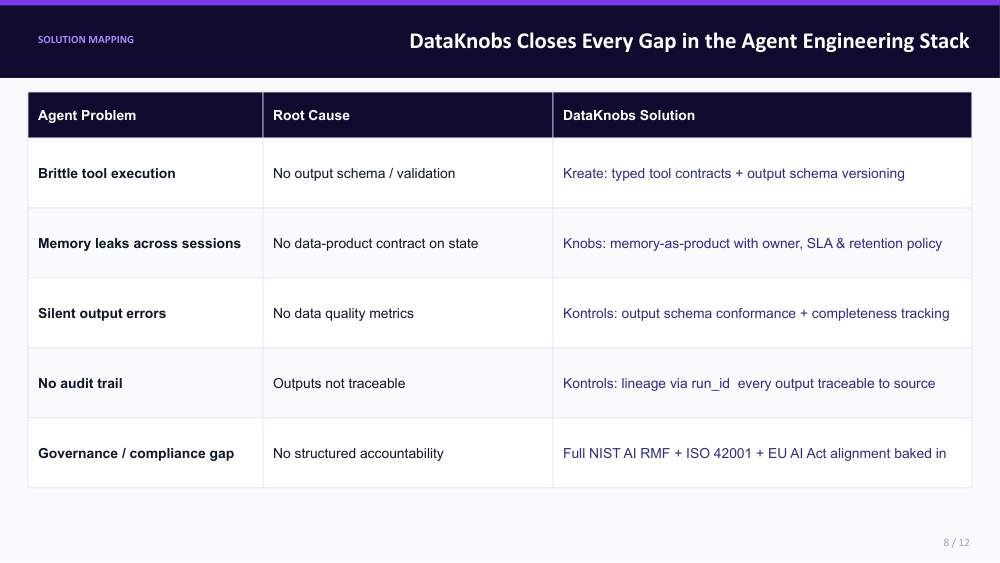
The mapping starts with the production failure, identifies the root cause, then assigns a platform mechanism for structure, governance, lineage, or policy enforcement.
| Agent problem | Root cause | DataKnobs solution in the deck |
|---|---|---|
| Brittle tool execution | No output schema / validation | Kreate: typed tool contracts + output schema versioning |
| Memory leaks across sessions | No data-product contract on state | Knobs: memory-as-product with owner, SLA & retention policy |
| Silent output errors | No data quality metrics | Kontrols: output schema conformance + completeness tracking |
| No audit trail | Outputs not traceable | Kontrols: lineage via run_id, every output traceable to source |
| Governance / compliance gap | No structured accountability | Deck states NIST AI RMF + ISO 42001 + EU AI Act alignment is built in |
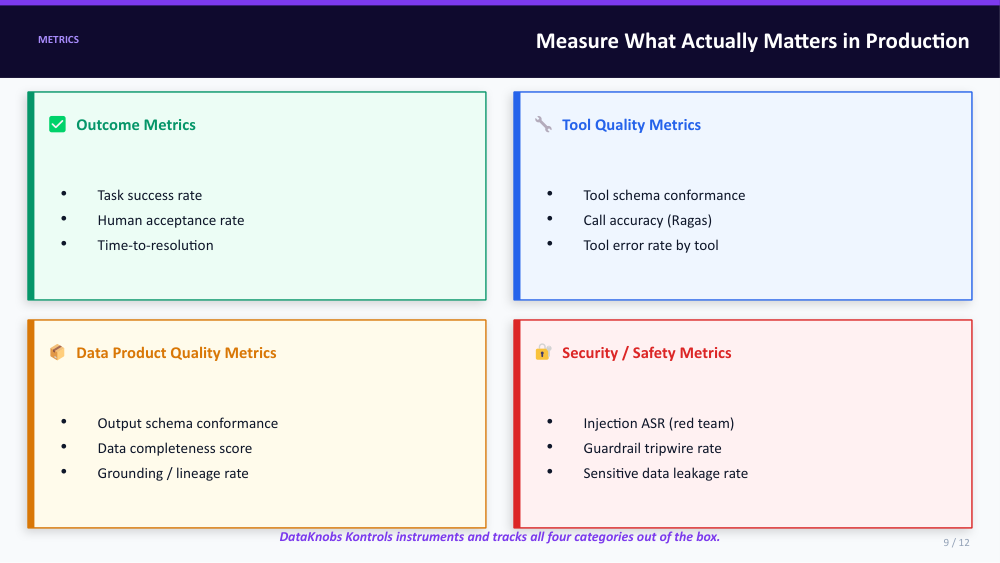
The deck uses four metric families so teams measure outcomes, tools, data products, and security rather than only model-level indicators.
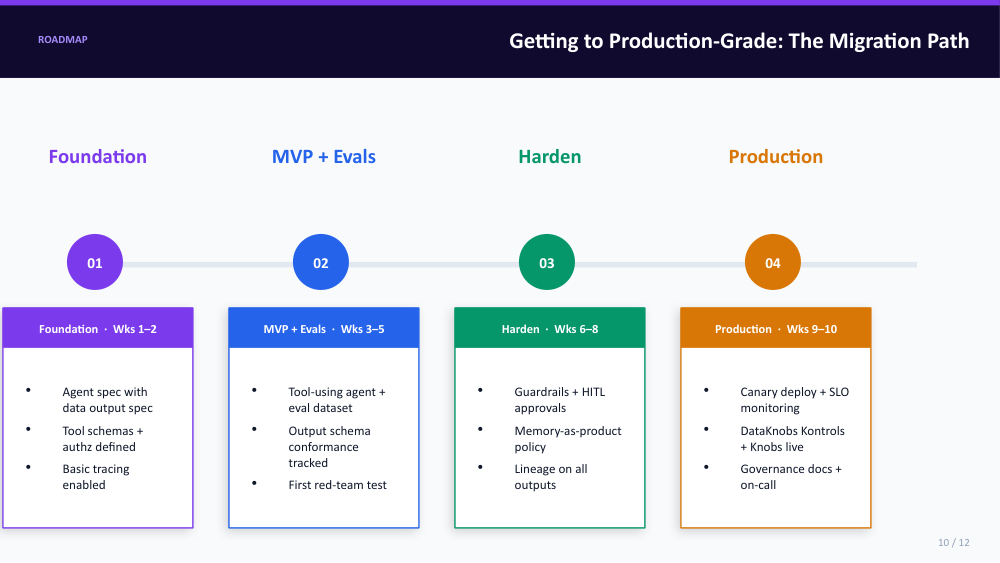
The deck proposes a ten-week path from agent specification and tracing through evals, hardening, canary deployment, SLO monitoring, governance, and on-call readiness.
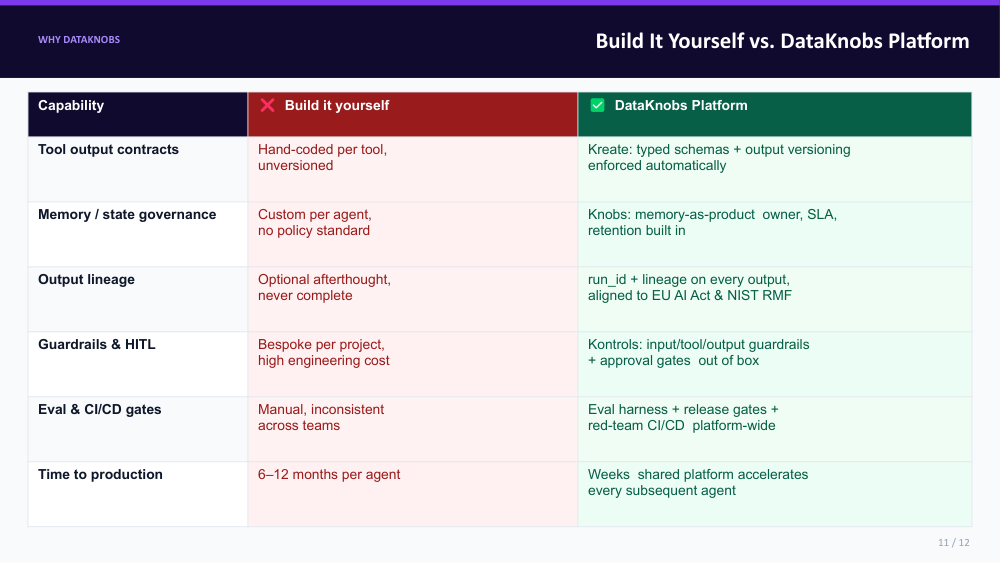
The deck contrasts bespoke per-agent engineering with a shared platform for tool contracts, memory governance, lineage, HITL, eval gates, and repeatable time-to-production.
| Capability | Build it yourself | DataKnobs platform |
|---|---|---|
| Tool output contracts | Hand-coded per tool, unversioned | Kreate: typed schemas + output versioning enforced automatically |
| Memory / state governance | Custom per agent, no policy standard | Knobs: memory-as-product owner, SLA, retention built in |
| Output lineage | Optional afterthought, never complete | run_id + lineage on every output; deck states EU AI Act & NIST RMF alignment |
| Guardrails & HITL | Bespoke per project, high engineering cost | Kontrols: input/tool/output guardrails + approval gates out of box |
| Eval & CI/CD gates | Manual, inconsistent across teams | Eval harness + release gates + red-team CI/CD platform-wide |
| Time to production | 6-12 months per agent | Deck claims weeks, with the shared platform accelerating subsequent agents |
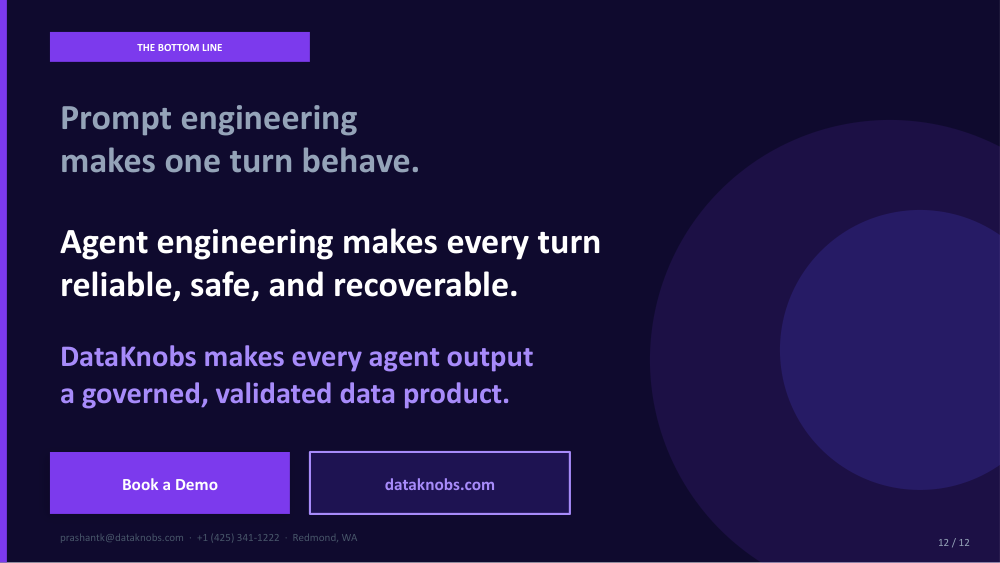
+1 (425) 341-1222 · Redmond, WA · Source deck: Confidential · DataKnobs 2026