AIAgent AI Framework
Enterprise Agentic AI

Agent AI Framework

A practical roadmap to move from AI-agent strategy to reusable architecture, production deployment, governance, replication, and ultimately an ecosystem of cooperating agents.

Agent AI Framework overview slide

The slide deck provides the visual backbone; the article below expands the roadmap into an implementation-oriented guide.

Roadmap

From intent to institutional capability

The framework treats Agent AI as a lifecycle. Start with business intent, prove value in a focused pilot, then standardize, govern, and reuse the capability across the enterprise.

01

Adoption Framework

Define the operating model, stage gates, ownership, and decision criteria for agent adoption.

02

Strategy & Vision

Clarify why Agent AI matters, which outcomes it should improve, and the acceptable risk profile.

03

Use Case Identification

Prioritize workflows by value, feasibility, data readiness, and operational risk.

04

Architecture & Infra

Design reusable layers for reasoning, memory, tools, knowledge, interfaces, and governance.

05

Build Pilot

Prove one use case with measurable KPIs, tight scope, feedback, and human oversight.

06

Productionize & Scale

Harden reliability, security, observability, deployment, testing, and cost controls.

07

Monitor & Govern

Continuously evaluate quality, safety, drift, tool behavior, access, and business outcomes.

08

Replicate

Reuse the same agent platform across adjacent workflows through configuration and modules.

09

Move from a single AI to cooperating minds

When a workflow becomes too broad for one agent, decompose it into specialized agents with explicit roles, shared context, and orchestration.

Implementation Framework

What each stage needs to answer

A strong agent program is not only a model choice. It connects business value, software architecture, operations, security, and governance from the beginning.

Strategy & Vision

Define outcomes before autonomy

  • Set target business outcomes such as cycle-time reduction, accuracy, customer experience, or compliance.
  • Agree on success metrics and boundaries for autonomous action.
  • Identify sponsors, process owners, data owners, and accountable operators.
Use Cases

Start where value is visible

  • Score candidate workflows by value, feasibility, risk, and data readiness.
  • Prefer a contained process with observable inputs, outputs, and measurable KPIs.
  • Define fallback behavior when the agent is uncertain or a tool fails.
Architecture

Build a modular foundation

  • Separate reasoning from domain logic, tools, knowledge, memory, and policy enforcement.
  • Use explicit interfaces for APIs, databases, document stores, and human approvals.
  • Design telemetry and auditability into the platform instead of adding them later.
Pilot

Prove behavior, not only a demo

  • Keep the scope narrow and maintain human-in-the-loop controls for consequential actions.
  • Log tool calls, decisions, errors, latency, and cost.
  • Test against representative scenarios, edge cases, and failure modes.
Production

Turn a pilot into a service

  • Standardize deployment, secrets, access controls, testing, and rollback.
  • Build reliability patterns for retries, timeouts, idempotency, and tool failures.
  • Track unit economics as well as quality and task success.
Governance

Operate within explicit guardrails

  • Apply least privilege to tools, data, and downstream actions.
  • Maintain traceability for prompts, context, retrieved knowledge, tool calls, and outputs.
  • Use human checkpoints where risk, policy, or uncertainty requires escalation.
Replication

Reuse the platform, vary the domain

  • Package common memory, logging, authentication, prompt, and monitoring components.
  • Parameterize domain-specific policies, tools, taxonomies, and knowledge sources.
  • Favor configuration-over-code when the underlying behavior is shared.
Multi-Agent

Decompose complex work into roles

  • Use specialist agents for extraction, analysis, planning, execution, and advisory tasks.
  • Introduce an orchestrator only when task boundaries, handoffs, and state are clear.
  • Control shared context carefully to avoid duplication, drift, and conflicting actions.
Context & MemoryState, history, user and task context
ReasoningPlanning, decisions, model orchestration
Tools & IntegrationsAPIs, data stores, apps, workflows
ExperienceChat, workflow UI, dashboards, APIs
GovernanceSecurity, policy, monitoring, audit
Slide 14

Dataknobs approach

The final slide emphasizes a progression from standardization to institutionalization: establish a reusable core, modularize domain behavior, orchestrate specialized agents, automate delivery, and build a durable operating model.

Standardize
  • Define a common agent architecture template.
  • Create reusable authentication, logging, monitoring, and prompt components.
  • Build shared governance, compliance, and security policies.
Modularize
  • Isolate business logic by domain.
  • Plug domain modules into the core framework.
  • Use a configuration-over-code model for faster deployment.
Orchestration
  • Enable specialized agents to collaborate.
  • Add routing or orchestration for sequential tasks.
  • Leverage shared memory and context across agents.
Automate
  • Containerize agents for repeatable deployment.
  • Automate testing and rollout pipelines.
  • Centralize monitoring for behavior, drift, and ROI.
Institutionalize
  • Capture feedback across agents for continuous improvement.
  • Maintain a shared knowledge base.
  • Establish a center of excellence for governance and reuse.
The webpage deliberately keeps the 14 original slides as first-class content rather than redrawing them. That preserves the source material while the surrounding article adds navigation, responsive loading, accessibility, and implementation context.
Source Deck

All 14 slides

Each image uses responsive variants from the `Slide600`, `Slide700`, `Slide900`, and `Slide1000` folders. Click any slide to open a larger view.

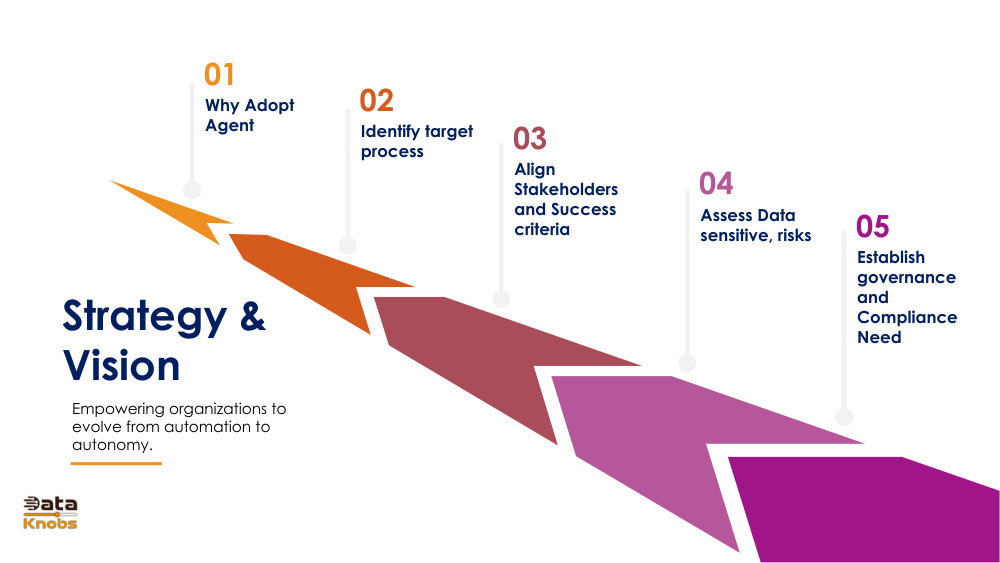
Slide 1 of 14

Click to enlarge
Agent AI Framework slide 1 of 14

Slide 2 of 14

Click to enlarge
Agent AI Framework slide 2 of 14

Slide 3 of 14

Click to enlarge
Agent AI Framework slide 3 of 14

Slide 4 of 14

Click to enlarge
Agent AI Framework slide 4 of 14

Slide 5 of 14

Click to enlarge
Agent AI Framework slide 5 of 14

Slide 6 of 14

Click to enlarge
Agent AI Framework slide 6 of 14

Slide 7 of 14

Click to enlarge
Agent AI Framework slide 7 of 14

Slide 8 of 14

Click to enlarge
Agent AI Framework slide 8 of 14

Slide 9 of 14

Click to enlarge
Agent AI Framework slide 9 of 14

Slide 10 of 14

Click to enlarge
Agent AI Framework slide 10 of 14

Slide 11 of 14

Click to enlarge
Agent AI Framework slide 11 of 14

Slide 12 of 14

Click to enlarge
Agent AI Framework slide 12 of 14

Slide 13 of 14

Click to enlarge
Agent AI Framework slide 13 of 14

Slide 14 of 14

Click to enlarge
Agent AI Framework slide 14 of 14
Expanded slide preview