A prompt edit ships. The canary looks fine for forty minutes. Twelve hours later an enterprise tenant opens a ticket over a sub-route the regression suite never touched. Agent deployment isn't a deploy — it's a sequence of gates, each answering a different question about whether the candidate is actually ready.
Agent deployment is the discipline of releasing a new agent version — a prompt edit, a model swap, a tool change — into production without risking the stability of what's already running. Because a request can trigger a different tool sequence each run, a deployment can degrade silently: the system keeps responding, but the quality of those responses quietly drops. The reliable pattern is a four-stage gate — shadow (validate against real traffic with no user exposure), canary (a small live cohort sees it), percentage (gradual ramp with automated rollback triggers), and full rollout — with each stage answering a genuinely different question, so skipping one doesn't just add risk, it removes the only check that would have caught a specific class of failure.
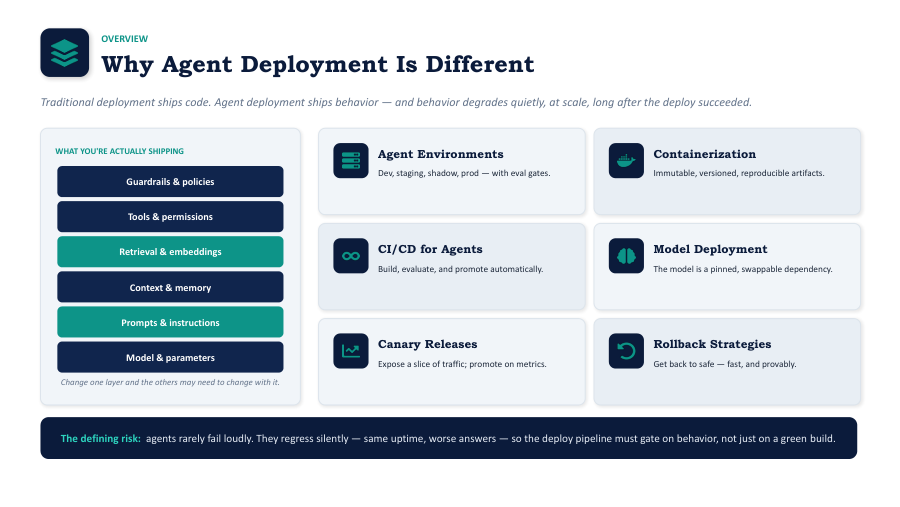
Standard software deployments version code. Agent deployments version three tightly coupled artifacts simultaneously — code, data, and model or prompt weights. A change to any one of them can break production silently: the system keeps serving responses, they just quietly get worse.
Traditional CI/CD pipelines are built to catch compilation errors and failed unit tests, neither of which fires when a prompt edit subtly breaks a tool-call schema on one sub-route. That gap is exactly what a staged rollout, with real evaluation at each stage, is designed to close.
Skipping a stage doesn't just add risk generically — it removes the specific check that stage exists to perform.
Routing determines which version a given request takes. A separate evaluation stack decides whether the candidate is actually good enough to move to the next stage — the same scoring templates that gate a pull request in CI also score the canary's live traffic, so a regression looks the same wherever it's caught.
Mirrors real traffic, no user exposure. Does the candidate behave reasonably on the actual distribution?
A small live cohort sees real responses. Is it at least as good with real users in the loop?
Gradual ramp with automated gates. Does quality hold as volume and diversity increase?
Complete cutover. Monitoring and rollback readiness stay active, not just the ramp.
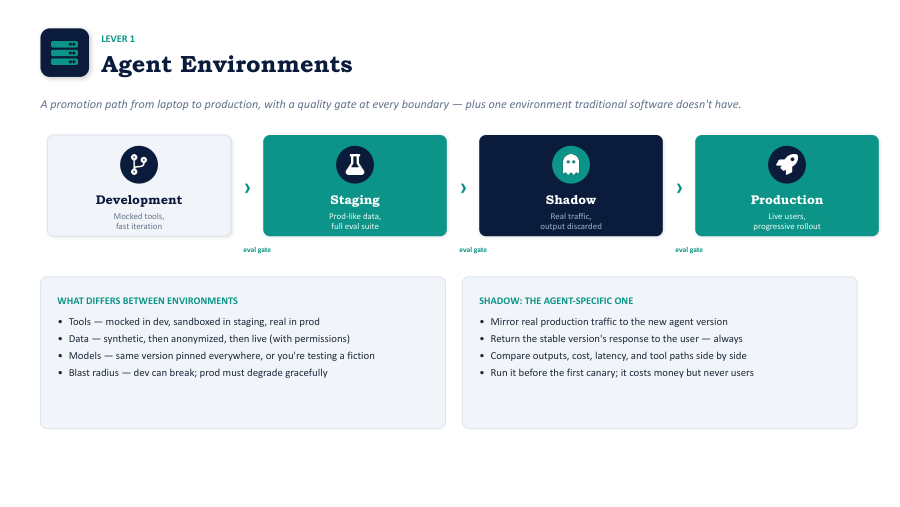
Shadow deployment mirrors real production requests to the candidate version, scores the responses, and never shows them to a user. It's the cheapest signal-gathering stage available and it's the one teams skip most often — going straight from an offline eval to a live canary — which leaves out exactly the phase where most candidate tuning actually happens.
A common mistake is treating shadow as a one-shot check before canary rather than a standing practice. Production distribution drifts over time, and a rubric only catches that drift if shadow traffic keeps running continuously, not just once before a specific release.
Unlike shadow, a canary's response actually reaches a limited live cohort — usually 5 to 10 percent of traffic — which means quality, cost, latency, safety, and task outcome all need tracking by cohort, not just in aggregate. The candidate has to prove it's at least as good as the current version with a real user in the loop, not just plausible against a shadow sample.
The canonical failure story: mean groundedness holds at 0.91 across the canary while one affected sub-route quietly runs at 0.62. The aggregate looked fine because it was a mean, not a percentile, and the gate that would have caught it was watching the wrong statistic.
Blue-green keeps two identical production environments running. The new version deploys to the inactive one, gets tested thoroughly in isolation, and traffic switches over only once it's verified — with rollback as simple as switching back to the environment that was never touched.
A/B testing systematically compares two versions against business metrics, not just model accuracy, using real statistical rigor to determine which one actually performs better for users — a distinct question from whether the candidate is safe, which is what shadow and canary are for.
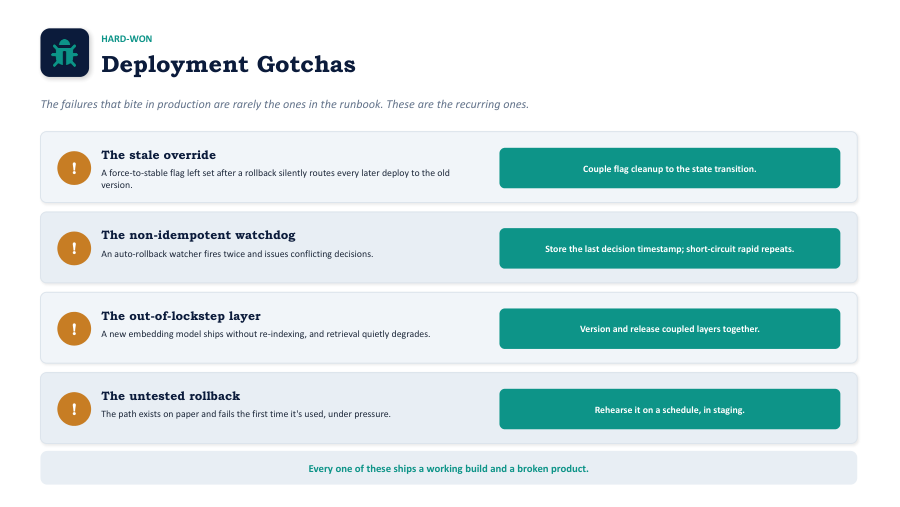
Each of these produces a rollout that looks healthy on the dashboard right up until it isn't.
None of these are exotic failure modes — they're the specific, recurring gaps that a rollout process which looks complete on paper still quietly has.
A prompt update might require a different retrieval strategy. A new embedding model demands a full database re-index. Release orchestration exists to make sure that when one layer changes, its dependencies get automatically tested and deployed in lockstep, rather than drifting out of sync until someone notices in production.
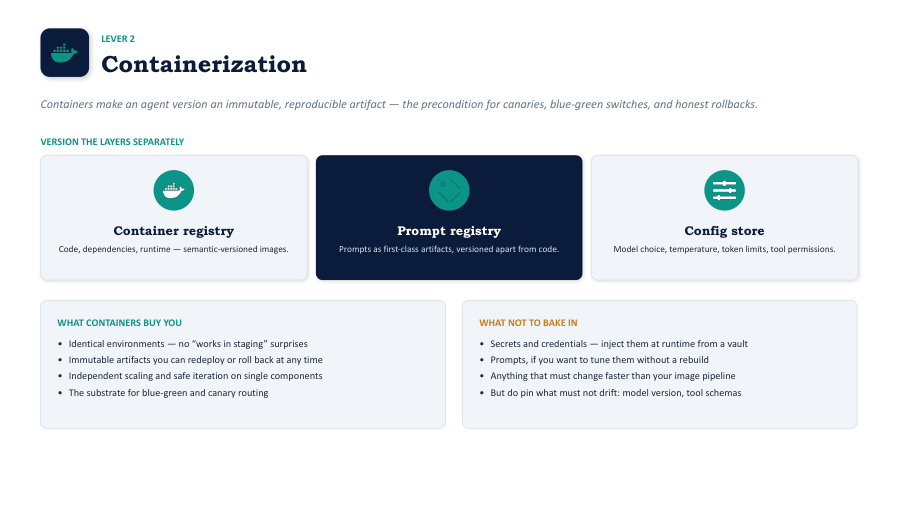
The practical foundation underneath this is treating prompts and configurations as code — version-controlled, reviewed, and tied to the same CI pipeline as everything else — rather than editing a live prompt directly and hoping the rest of the stack still matches it.
Safe deployment embeds guardrails at the input, output, and action levels, and pairs them with immutable logging so any production decision can be traced back to the exact version of the stack that produced it — not an approximate release window, an exact commit, model version, and training run.
Model lineage should include the training data hash and the code SHA behind every deployed version, deployment events should land in an immutable audit trail, and access control should ensure developers can't push directly to a production namespace — the same discipline traditional infrastructure has carried for years, applied to a stack that changes far more often.
The organizations that succeed won't be the ones with the smartest standalone model — they'll be the ones who master the orchestration required to deploy and evolve agents safely, alongside everything else they ship, on the same release cadence and the same standards of evidence.
The single habit that separates a rollout process that looks complete from one that actually is: a rollback procedure that's been tested, not just written. Documentation describes what should happen; a rehearsed rollback proves it actually does, cache flush included.
Shadow deployment mirrors real production traffic to a candidate version and scores its responses without ever showing them to a user. Canary deployment sends the candidate's actual response to a small, real, live cohort of users, which means real quality, cost, and safety metrics have to be tracked by cohort rather than just estimated from a mirrored sample.
Because a standard deployment versions code alone, while an agent deployment versions code, data, and model or prompt weights simultaneously — and a change to any one of the three can degrade quality silently, since the system keeps responding without throwing the kind of error traditional CI/CD is built to catch.
It describes a canary rollout where an aggregate quality metric looks healthy while one specific sub-route or segment is badly broken — the mean hides the failure because it averages across traffic that wasn't affected. The fix is gating on percentiles and failure clusters within the traffic, not solely on an aggregate mean.
Most often because a semantic or response cache keeps serving the bad candidate's cached answers until its TTL naturally expires, even after traffic has been routed back to the previous version. A rollback procedure needs to include an explicit cache flush as part of the rollback itself, not just a routing change.
It means automatically keeping dependent layers in sync when one changes — a prompt edit that needs a different retrieval strategy, or a new embedding model that requires re-indexing a database — rather than deploying each layer independently and hoping they stay compatible. It treats the whole stack as one coordinated release, not several separate ones.
At minimum: shadow validation completed before first canary exposure, canary steps with automated metric gates and rollback conditions, a warm fallback environment retained for at least 24 hours post-promotion, a rollback procedure that's been tested rather than just documented, and every deployment traceable to a specific git commit, model version, and training run.
Run the full four-stage gate before the next prompt or model change goes live, and rehearse the rollback — cache flush included — before you need it for real.