Agentic AI · Systems Architecture

One agent, or a
team of them?

Multi-agent systems split a task across specialized agents that coordinate, hand off work, and check each other's output. Done well, they beat a single generalist agent. Done by default, they mostly add token cost and coordination overhead for no real gain.

SLIDE 01 — MULTI-AGENT SYSTEMS
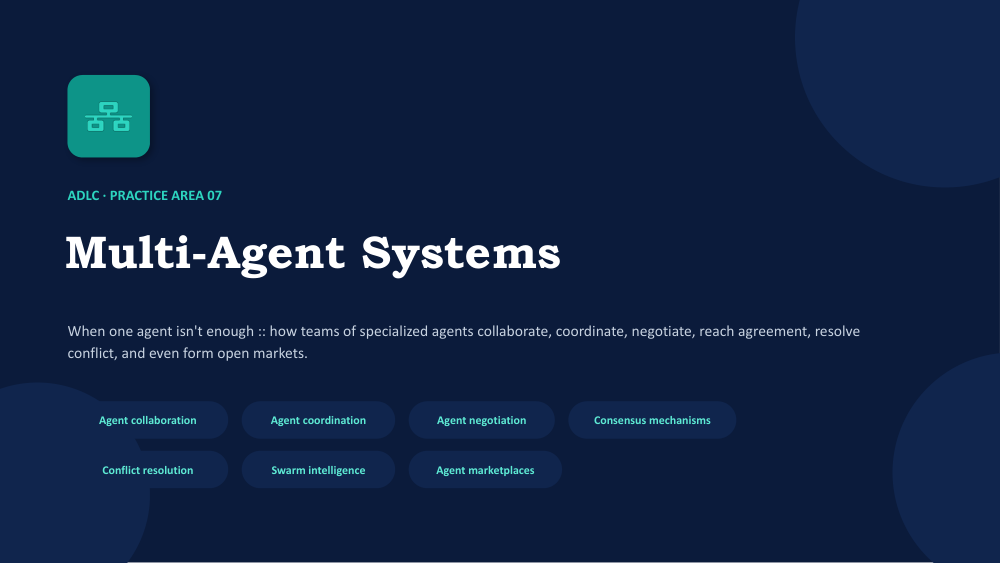
Cover slide: Multi-Agent Systems
Quick answer

A multi-agent system coordinates two or more LLM-driven agents — each with a distinct role, prompt, model tier, or tool set — to complete a task that one generalist agent would handle worse, slower, or not at all. Three conditions justify the added complexity: specialization (a focused agent genuinely outperforms a generalist), parallelism (independent sub-tasks can run at once and shorten wall-clock time), or critique (a separate critic agent measurably improves quality beyond what self-review inside one agent achieves). Six orchestration patterns cover almost every production system: supervisor/worker, hierarchical, swarm, pipeline, debate, and fan-out — and the honest number worth knowing upfront is that multi-agent setups typically carry 58% to 285% more token overhead than a single well-designed agent, so it pays to confirm one of those three conditions actually applies before reaching for a team.

SLIDE 02 — WHEN MULTI-AGENT ACTUALLY PAYS OFF
Three conditions that justify a multi-agent architecture
Not a default, a decision

Earn the added complexity

It's one of the most over-prescribed shapes in applied AI: reaching for multiple agents because it sounds more sophisticated than it needs to be. A single well-scoped agent, given the right tools and enough context, handles most tasks just fine.

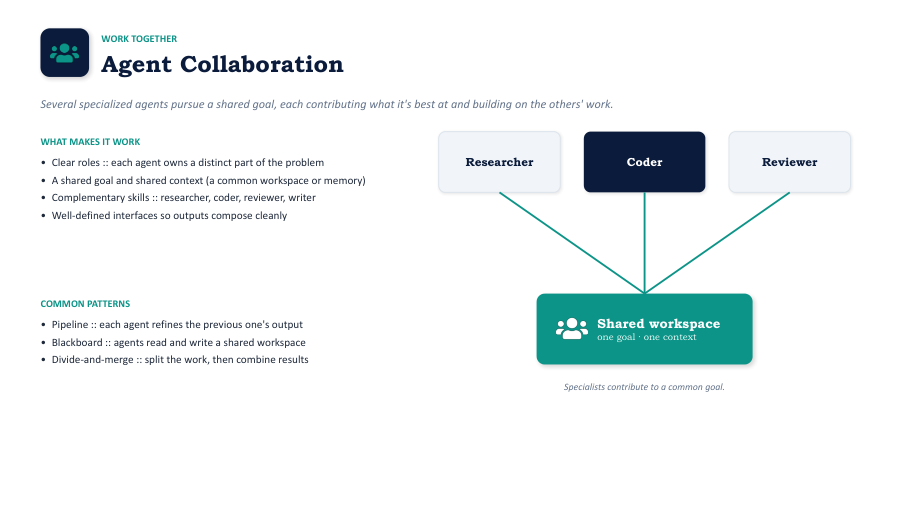
  • Specialization — a focused agent with a narrow prompt and tool set genuinely outperforms a generalist on this sub-task
  • Parallelism — independent sub-tasks can run at the same time, shortening wall-clock time on a task a single agent would do serially
  • Critique — a separate critic agent, reviewing with fresh eyes, catches errors that self-review inside one agent reliably misses
The orchestration patterns

Six shapes cover almost every production system

Each pattern is a different answer to the same question: who decides what happens next, and how do results get back together.

SLIDE 03 — SUPERVISOR / ORCHESTRATOR-WORKER
Supervisor pattern: central coordinator dispatching to worker agents
The 2026 production default

One coordinator, several specialists

A central supervisor receives the goal, breaks it into subtasks, routes each to a specialist worker agent, and synthesizes the results. This is by far the most common shape in production — by some estimates, around seventy percent of deployed multi-agent systems use this orchestrator-worker topology.

It gives clear control and simple debugging, since every decision flows through one place. The trade-off is exactly that centralization: the supervisor is a potential bottleneck, and its growing context window — not the worker calls — usually dominates token spend.

SLIDE 04 — HIERARCHICAL (SUPERVISORS OF SUPERVISORS)
Hierarchical pattern: nested supervisors managing specialist worker teams
When one layer of delegation isn't enough

A tree of supervisors, not just workers

Hierarchical systems stack supervisors into levels: a top-level orchestrator delegates to mid-level supervisors — say, a research team lead and a code team lead — each of whom manages their own team of specialist workers. Higher levels focus on coordination and planning; lower levels focus on execution.

This earns its added coordination overhead only when task complexity genuinely spans multiple distinct domains of expertise. Adding a hierarchy layer to a task a single supervisor could already handle just adds latency and cost without a matching benefit.

SLIDE 05 — SWARM / DECENTRALIZED PEER-TO-PEER
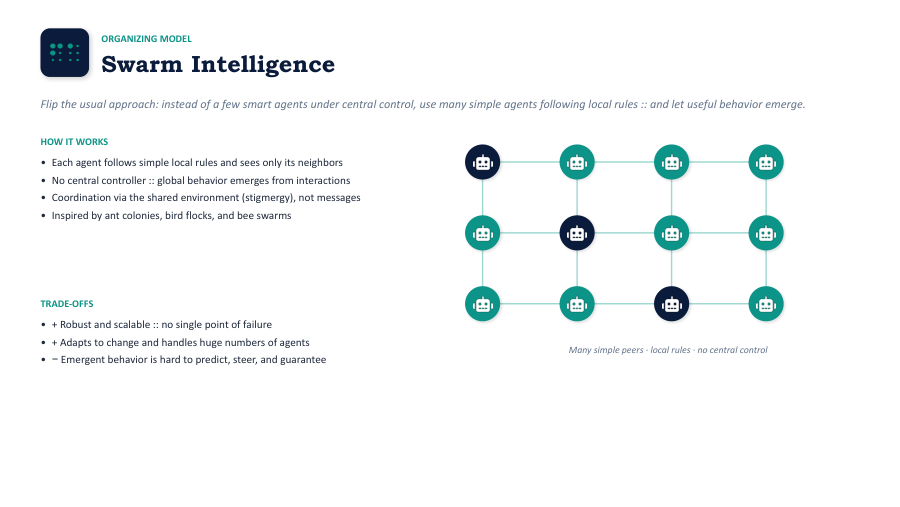
Swarm pattern: peer agents coordinating without central control
No single point of failure — or control

Peers, not a chain of command

In a swarm, autonomous agents work in parallel with minimal central coordination — sharing information directly with neighbors or through a publish-subscribe message bus, rather than reporting to a supervisor. There's no single bottleneck and no single point of failure.

The cost shows up elsewhere: without a coordinator, getting the overall system to converge on a coherent result becomes significantly more complex to reason about and to debug. Swarm shows up most often in research-and-summarize tasks, where independent parallel exploration genuinely pays off.

SLIDE 06 — PIPELINE / SEQUENTIAL
Pipeline pattern: agents processing work in sequence
The simplest topology that still counts as multi-agent

Each agent refines what the last one made

Pipeline agents process work in a fixed sequence, each one refining the previous agent's output — a drafting agent, then an editing agent, then a fact-checking agent, in a straight line. Every step depends on the one before it, which makes the flow easy to reason about and debug, but also fully serial: no step starts before the last one finishes.

It fits workflows with a genuinely natural sequence — draft, then edit, then verify — better than tasks where steps could just as easily run in parallel.

SLIDE 07 — DEBATE / CONSENSUS
Debate pattern: multiple agents argue perspectives, a judge arbitrates
Paying for a second opinion

Two perspectives, a judge decides

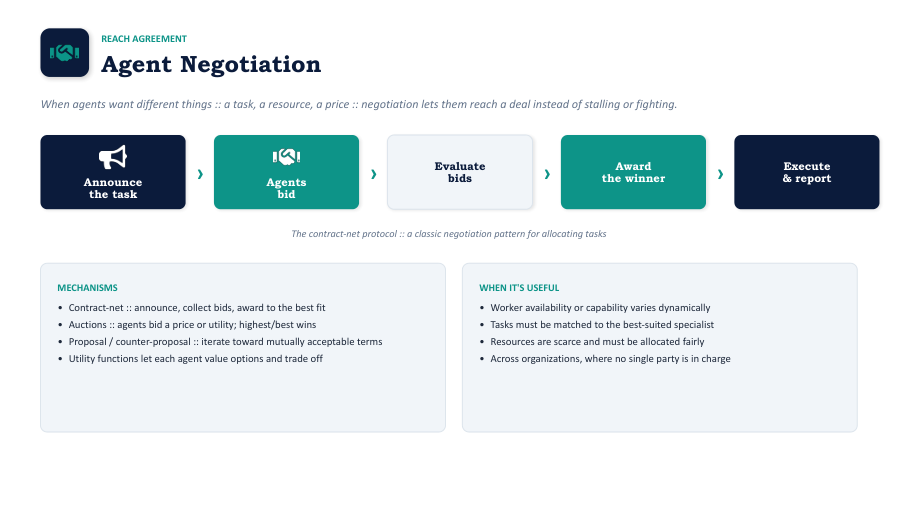
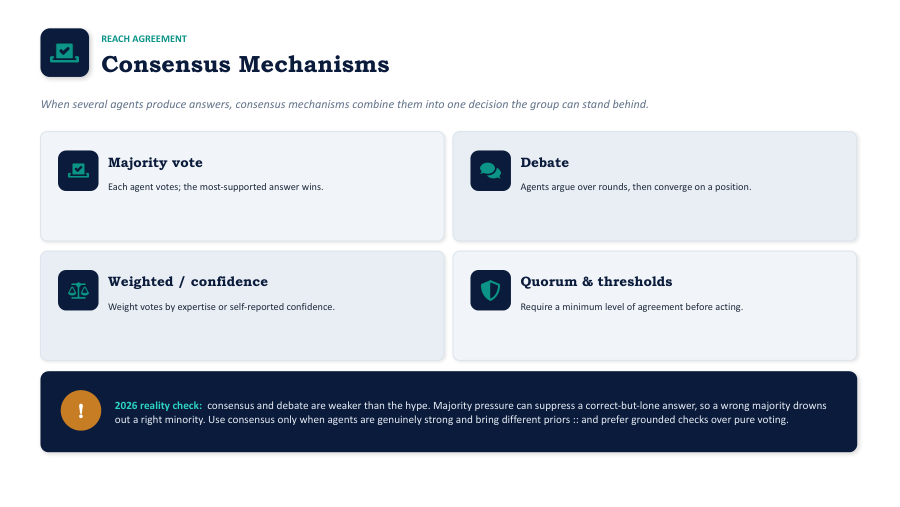
In the debate pattern, two or more agents argue different perspectives on the same problem, and a separate judge — sometimes a different model entirely — arbitrates between them. It's the clearest way to operationalize the "critique" condition for going multi-agent: a genuinely independent second opinion catches errors a single agent's self-review misses.

The cost is real and worth quoting plainly: running a debate pattern typically costs around two and a half times a single-model call. Reserve it for decisions where being wrong is expensive enough to justify that premium.

Quick reference

All six patterns, at a glance

Central control
Supervisor / Worker

One coordinator dispatches and synthesizes. The 2026 production default.

Nested control
Hierarchical

Supervisors of supervisors, for genuinely multi-domain complexity.

No central control
Swarm

Autonomous peers, parallel exploration, harder to coordinate.

Fixed order
Pipeline

Sequential hand-offs, each agent refining the last one's output.

Adversarial
Debate

Competing perspectives plus a judge; costly but high-assurance.

Scatter-gather
Fan-out

Parallel dispatch to independent workers, results gathered back.

SLIDE 08 — COORDINATION & SHARED STATE
Diagram of shared state and coordination challenges in multi-agent systems
Where multi-agent POCs actually fail

Context loss, not pattern choice, sinks most systems

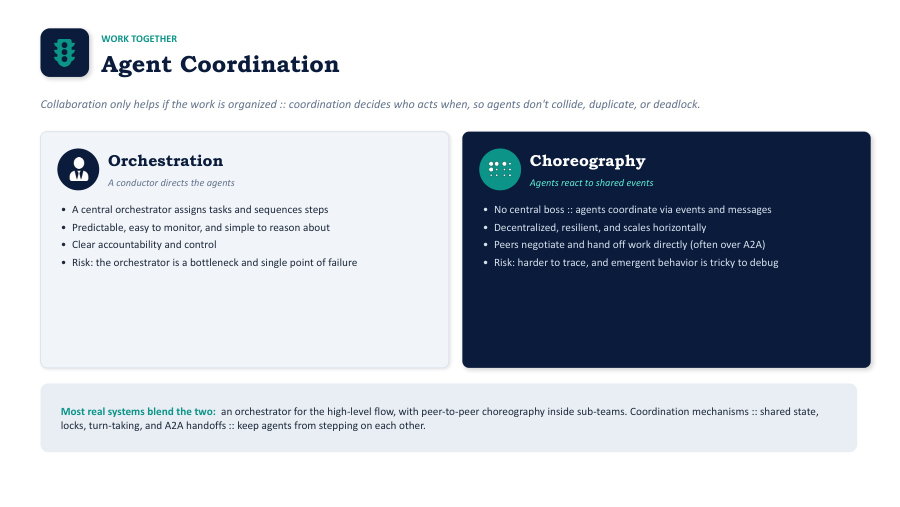
Every orchestration pattern needs the same underlying thing: persistent, shared state that survives beyond any single agent's turn. Without it, systems hit the same handful of failures no matter which pattern they picked.

  • Context loss — intermediate results disappear between agent hand-offs
  • Payload bloat — full context gets re-passed through every hand-off instead of a reference to shared state
  • Race conditions — two agents overwrite each other's work with no coordination
  • Recovery failures — no checkpoint exists to resume from after a crash

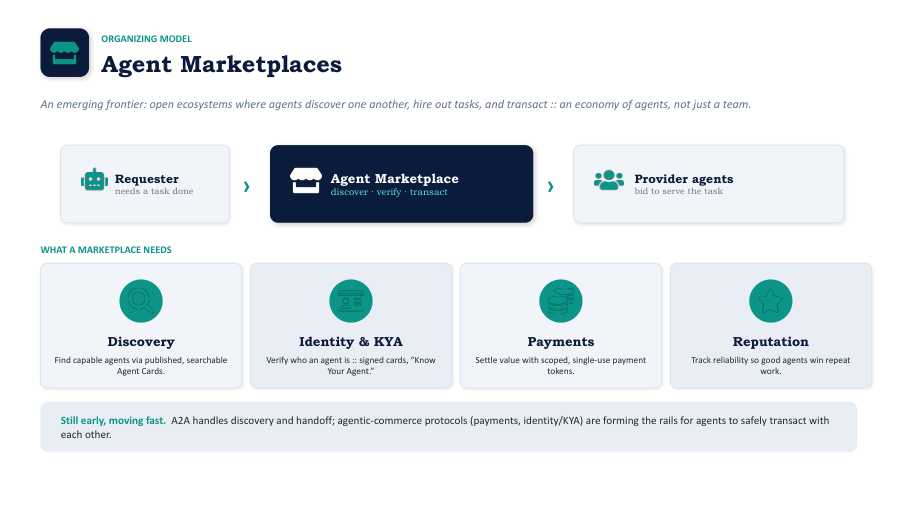
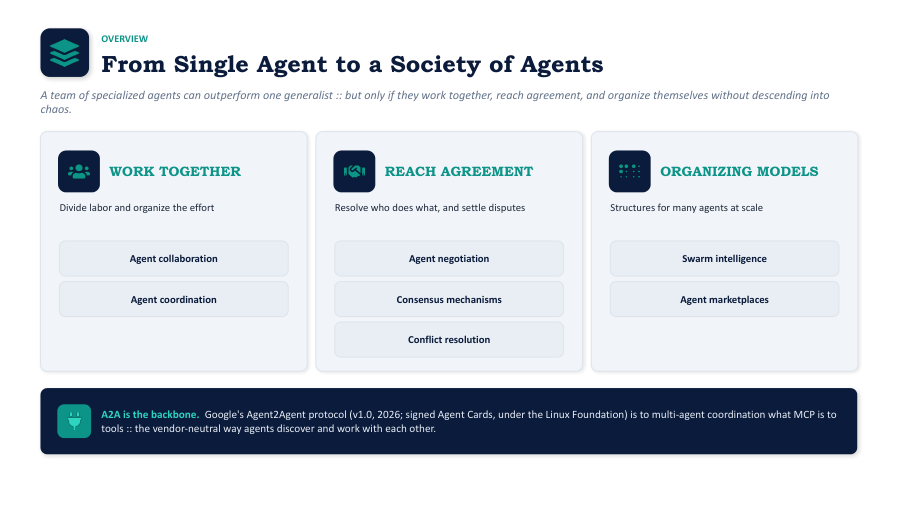
Cross-vendor communication has its own emerging standard: the A2A protocol, now under the Linux Foundation, defines how agents from different frameworks or vendors can talk to each other regardless of which orchestration pattern sits on top.

The honest cost picture

Multi-agent is not free parallelism

Every added agent adds tokens, and the coordination overhead compounds faster than most teams expect.

SLIDE 09 — TOKEN ECONOMICS BY TOPOLOGY
Token overhead by multi-agent topology, and model tiering by role
Where the spend actually goes

The supervisor's context, not the workers, drives cost

Independent, decentralized setups typically run around 58% more token overhead than a comparable single agent; centralized supervisor setups can run closer to 285% more, because every worker result eventually flows back through — and grows — the supervisor's own context window.

A common cost lever is model tiering: a larger, more capable model for the planner or supervisor role, and smaller, cheaper models for routing classifiers and narrow worker tasks — since the supervisor's reasoning quality matters more to the outcome than any single worker call.

TopologyTypical token overheadCost driver
Single agent (baseline)0%
Independent / decentralized~58% extraRedundant context across peers
Centralized / supervisor~285% extraSupervisor's growing context window
Debate / consensus~2.5x a single callMultiple full reasoning passes plus a judge
SLIDE 10 — MATCHING PATTERN TO TASK
Summary: matching an orchestration pattern to task characteristics
The decision that matters most

Pattern follows task, not the other way around

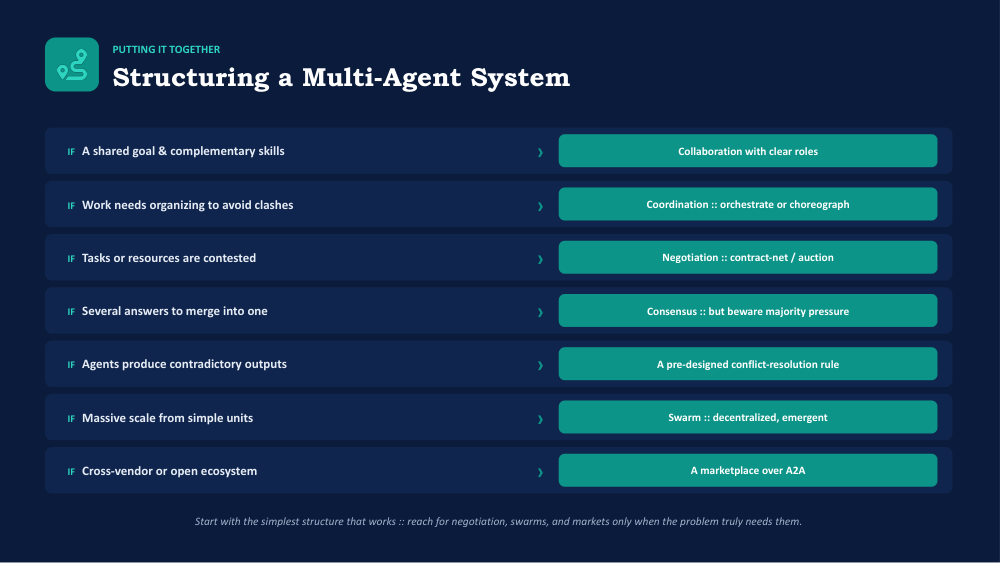
Real systems often combine patterns — a hierarchical structure might run a pipeline inside each team, or a supervisor might spawn a swarm for a burst of parallel exploration before synthesizing the results. None of these hybrids are wrong; the mistake is picking a shape before understanding what the task actually needs.

Start with a single agent. Add a second only when specialization, parallelism, or critique clearly earns its keep — and budget for the token overhead that comes with it, honestly, before it shows up in a bill.

Frequently asked

Multi-agent systems FAQ

When at least one of three conditions clearly holds: a specialized agent measurably outperforms a generalist on the sub-task, independent sub-tasks can genuinely run in parallel and save wall-clock time, or a separate critic agent catches errors that self-review inside one agent reliably misses. If none of these apply, a single well-scoped agent is usually both cheaper and simpler to debug.

The supervisor / orchestrator-worker pattern, used in an estimated seventy percent of production multi-agent deployments. A central coordinator breaks the goal into subtasks, routes each to a specialist worker, and synthesizes the results — offering clear control at the cost of the supervisor becoming a potential bottleneck.

Decentralized, independent setups typically run around 58% more token overhead than a single agent; centralized supervisor setups can run closer to 285% more, largely because the supervisor's context window keeps absorbing every worker's output. Debate patterns with a judge model run around 2.5 times the cost of a single model call.

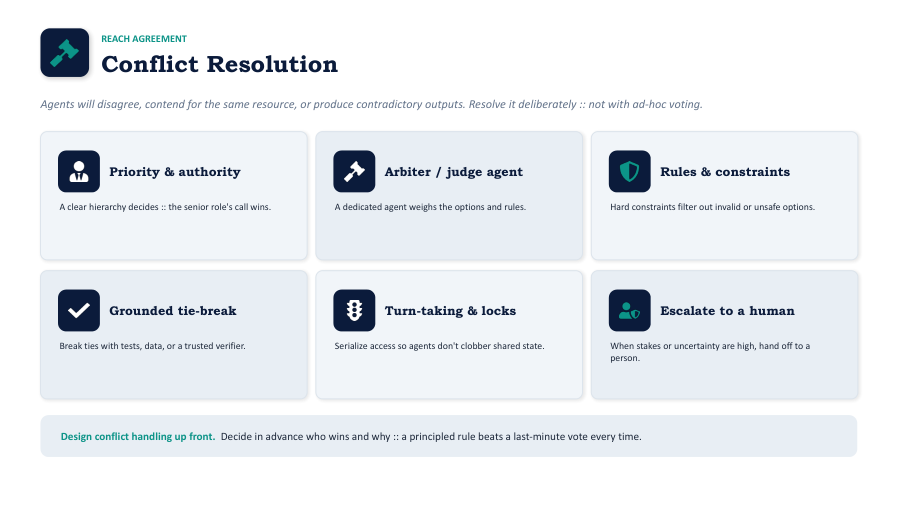
Hierarchical stacks supervisors into levels, with higher levels planning and coordinating while lower levels execute — still fundamentally centralized, just at multiple tiers. Swarm has no central coordinator at all: autonomous peer agents work in parallel and share information directly with each other, which removes the bottleneck but makes overall coordination harder to reason about.

Usually not because of the orchestration pattern chosen, but because of missing persistent shared state — leading to context loss between hand-offs, bloated payloads re-passed at every step, race conditions where agents overwrite each other's work, and no checkpoint to recover from after a crash. Solving coordination and state management matters more than picking the "right" topology.

Agent-to-Agent (A2A) is an open standard, now under the Linux Foundation, for cross-vendor agent communication — letting agents built on different frameworks or by different vendors coordinate regardless of which orchestration pattern sits above them.

Get started

Ready to design your agent team?

Start with a single agent, confirm one of the three conditions before adding a second, and pick the orchestration pattern that matches your task's actual shape — not the most impressive-sounding one.