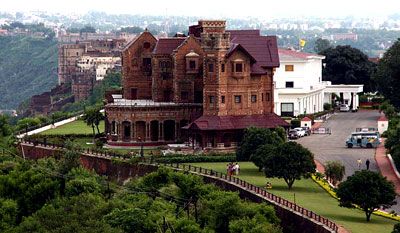
Of all the palace architecture scattered across India, Amar Mahal is one of the stranger imports. Built on a hilltop above the Tawi River in Jammu, it looks, at first glance, like it's been lifted from the Loire Valley and set down in the Himalayan foothills turrets, spires, sloping ridged roofs, all built not in granite or limestone but in the same red sandstone used throughout the region. It was the last home built by the Dogra dynasty, and it remains one of Jammu's most distinctive landmarks.
A palace built by the Dogras
Amar Mahal Palace was built in the 1890s by Raja Amar Singh, a ruler of the Dogra dynasty, which governed the princely state of Jammu and Kashmir. Sources differ slightly on the exact decade some date the building to 1862, others to the later 1890s but there is broad agreement that it was constructed in the second half of the 19th century, on a hilltop site overlooking the Tawi River, with the Shivalik Hills visible to the north.
The palace went on to serve as the last official residence of the Dogra dynasty. Maharani Tara Devi, the widow of Maharaja Hari Singh the last ruling Maharaja of Jammu and Kashmir before it joined independent India lived in the palace until her death in 1967, making Amar Mahal one of the final living links to the Dogra court.
A French architect, a Dogra king, and a palace that ended up being the last home a dynasty ever built.
A French château, reimagined
The palace's most distinctive feature is its architecture. Designed by a French architect, Amar Mahal borrows directly from the visual language of French chateaux pointed turrets, narrow spires, and steeply sloping, ridge-tiled roofs while layering in details drawn from Indian palace design, giving the whole structure a hybrid character sometimes described as Indo-Saracenic. The exterior is built from red sandstone, which lends the palace a warm, slightly rough-edged texture quite different from the polished white marble more commonly associated with Indian royal architecture.
Some of the palace's window detailing reflects a third influence again: classical Greek-style triangular pediments set over ornate false columns, a flourish that sits oddly but somehow coherently alongside the French rooflines and Indian massing. When it was built, Amar Mahal was reportedly the tallest building in Jammu a status it held for some time before the city's later growth caught up with it.
French Chateau Roofline
Turrets, spires, and steeply sloped ridge-tiled roofs designed by a French architect.
Red Sandstone
The palace's primary building material, giving it a warm, regional texture.
Classical Window Details
Greek-style triangular pediments over ornate false columns on the facade.
Hilltop Setting
Overlooking the Tawi River, with the Shivalik Hills visible to the north.
The museum today
After the end of royal rule, the palace was donated by Dr. Karan Singh, son of the last Maharaja, to the Hari-Tara charitable trust, which converted it into a museum and continues to oversee its maintenance. Four of the palace's rooms now function as galleries, and the museum's collection ranges from the historically significant to the simply opulent most notably a golden throne weighing 120kg, decorated with golden lions at its corners, kept in a hexagonal room and viewed only through glass for security reasons.
Beyond the throne, the museum houses Pahari and Kangra miniature paintings, including a 47-piece series depicting the story of Nala Damayanti alongside scenes from the Mahabharata, a library of roughly 25,000 books spanning political science, fiction, religion, and philosophy, and a substantial collection of portraits documenting generations of the Dogra royal family.
Visitor note: Photography inside the museum may carry an additional charge, and the hexagonal room housing the golden throne is generally viewed through glass rather than entered directly, for security reasons. The palace is adjacent to Hari Niwas Palace, the former residence of Maharaja Hari Singh, now operated as a heritage hotel.